



Luis Romero Faúndez
Bionativa Technical Assistant Manager
Bacteriosis does not appear spontaneously. Before any symptoms are manifested, we find phytopathogenic bacteria surviving and multiplying on the surface of the plant, particularly in stomata, trichomes, lenticellas or other natural openings. This phase, called epiphytic, constitutes a fundamental epidemiological stage where bacteria coexist with the host without causing visible symptoms, but retaining the ability to initiate infective processes under favorable environmental conditions (Hirano and Upper, 2000; Agrios, 2005).
During this stage, microorganisms face a highly variable and hostile environment, characterized by fluctuations of ultraviolet radiation, temperature, humidity and availability of nutrients. Added to this is the competence exercised by the resident microbiome of the philosphere. These conditions limit the expression of genes associated with virulence and favor an ecological balance in which bacterial populations remain low levels compatible with the absence of disease (Vorholt, 2012; Xin et al., 2018).
However, when favorable environmental conditions coincide, particularly moderate temperatures and high relative humidity, epiphytic populations can increase rapidly to critical densities. In these circumstances, a cellular communication mechanism called Quorum Sensing, through which bacteria collectively perceive population density and coordinate the activation of genes related to virulence, mobility, adhesion and production of compounds associated with infection (Hartmann et al., 2024; Zheng et al., 2025).
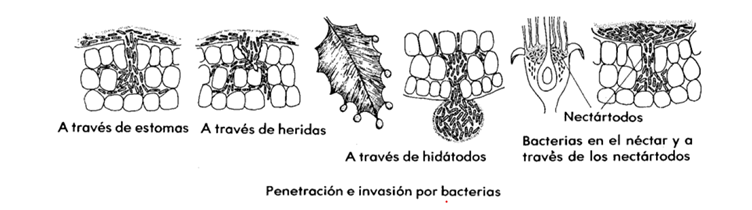
Agrios, G.N. 2005
From this point of view, the climate not only influences its direct effects on temperature or humidity, but also because certain climatic sequences facilitate epidemiological events that transform an epiphytic population into a virulent-infectious population. A rain after a period of population growth can disperse the inoculum; tempered temperatures after frost can favor entry to damaged tissues; while warm and wet days increase bacterial multiplication and its mobility on the plant surface. Consequently, environmental conditions function as risk regulators and not simply as accompanying factors of the disease (Agrios, 2005; Xin et al., 2018).
Communication mediated by Quorum Sensing is also closely related to the formation of Biofilms, Organized structures that allow bacteria to increase their survival, adhere to plant tissues and better resist stressful situations, such as lack of water, excess temperatures or tolerance to agrochemicals. It is also not by chance that the highest population densities are concentrated around stomata, lenticels, pruning wounds, frost injuries or bud openings, since these disruptions in the tissues constitute the main routes of entry to the plant (Hartmann et al., 2024; Krishna et al., 2022).
From an epidemiological perspective, free water acts as the main bridge for the dispersion and infection of phytopathogenic bacteria, while the temperature regulates the speed of the physiological processes of both the pathogen and the host. Therefore, the climate should be understood as a factor that controls the transit between the presence of bacteria on the plant surface and the effective establishment of the disease.
In carozo fruit trees for example for Chile, Pseudomonas syringae pv. syringae It is one of the main causative agents of bacterial cancer and to a lesser extent by Pseudomonas syringae pv. morsprunorum. These bacteria cause blight of flowers and darts, death of twigs, cankers and gummy exudations, generating significant economic losses in favorable seasons for the disease (Córdova et al., 2023).
Once the infection is established, P. syringae It can colonize the intercellular spaces of the apoplast, modulate the defensive responses of the host through specialized secretion systems and produce toxins that contribute to the development of symptoms. At the same time, the production of exopolysaccharides favors adhesion-advancement by the tissues, allowing the progression of the disease at the local and systemic level (Xin et al., 2018; Krishna et al., 2022).
Added to this unstable climate scenario is the growing concern about the appearance of populations with resistance to copper compounds or other bactericides traditionally used in agriculture. In the case of Chile, a history of resistance mainly to copper is handled both for Pseudomonas in cherry as Xanthomonas in walnut (d)Agurto, Esterio & Auger, 2000; Moya et al. 2018; Beltran et al, 2021) which requires strengthening preventive and integrated strategies, paying special attention to critical phenological processes such as sprouting and/or flowering, stages in which highly susceptible tissues and abundant opportunities for infection are generated associated with Micro-injuries-fissures typical of the aforementioned phenological processes.
The practical implication is clear: the bacterial risk must be managed before the appearance of symptoms. In orchards with a history of bacteriosis, it is essential to reduce inoculum sources, reduce dispersion from infected plants, and use protection strategies that integrate chemical products (rational use), biological tools based on competition or antibiosis (rotate action mode), defense inducers (Complement) and cultural management aimed at reducing the opportunities for infection (modify conditions). No tool alone is sufficient when there is high epidemiological pressure.
Finally, unstable weather conditions alone do not generate the disease, but they can synchronize the elements that make it very likely: elevated epiphytic populations, water dispersion, presence of wounds and susceptibility of the host. In a scenario where rain, heat, frost, dew and wind alternate, bacterial health should be understood as a dynamic risk management and not as a reaction after the symptom.
The question is no longer simply “Is bacteria present?”, but rather “when will they find the right combination of climate, population density and gateways to transform into disease?”
Bibliographic references
Agrios, G.N. (2005). plant pathology (5th ed.). Elsevier Academic Press.
Hirano, S.S., & Upper, C.D. (2000). Bacteria in the Leaf Ecosystem with emphasis on Pseudomonas syringae. Microbiology and Molecular Biology Reviews, 64, 624-653.
Vorholt, J.A. (2012). microbial life in the phyllosphere. Nature Reviews Microbiology, 10, 828-840.
Xin, X.F., Kvitko, B., & He, S.Y. (2018). Pseudomonas syringae: What it takes to be a pathogen. Nature Reviews Microbiology, 16, 316-328.
Krishna, P.S., Woodcock, S.D., Pfeilmeier, S., et al. (2022). Pseudomonas syringae addresses distinctive environmental challenges during plant infection through the coordinated deployment of polysaccharides. Journal of Experimental Botany, 73, 2206-2221.
Santamaría-Hernando, S., Cerna-Vargas, J.P., Martínez-García, P.M., et al. (2020). Blue-Light Perception by Epiphytic Pseudomonas syringae Drives ChemoReceptor Expression, Enabling Efficient Plant Infection. Molecular Plant Pathology, 21, 1606-1619.
Hartmann, A., Binder, T., & Rothballer, M. (2024). Quorum sensing-related activities of benefit and pathogenic bacteria have important implications for plant and human health. FEMS Microbiology Ecology, 100, FIAE076.
Córdova, P., Rivera-González, J.P., Rojas-Martínez, V., et al. (2023). Phytopathogenic Pseudomonas syringae As a Threat to Agriculture: Perspectives of Biological Control. Horticulture, 9, 712.
Agurto G., L., Estrio G., M., & Auger S., J. (2000). Resistance to copper ion in phytopathogenic bacteria in Chile.
Beltrán, M. F., Osorio, V., Lemus, G., miles, P., France, A., Correa, F., & Sagredo, B. (2021). Bacterial Community Associated with Canker Disease from Sweet Cherry Orchards of Central Valley of Chile Presents High Resistance to Copper. Chilean Journal of Agricultural Research, 81(3), 378–392.
Moya-Elizondo, E., Auil, P., Oyarzúa, P., & Gerding, M. (2018). Copper ion resistance of Xanthomonas arboricola pv. Juglandis in Nocedales of the Biobío region. Chilean Journal of Agricultural & Animal Sciences, 34(1), 3-11.

